

Box of Clouds
(This post includes affiliate links. Thank you for supporting my work!)
The month of June has been a rainy one in the metro area, and July has started out much the same way.
I’m afraid it may be partially my fault.
You see, there’s a saying in the astronomy & astrophotography world that whenever you buy a new telescope or get any new gear, your have basically purchased “a box of clouds.”
That is exactly what has happened. I recently purchased a new dedicated astrograph (a telescope designed for photography) and I have been able to get a total of 40 minutes of clear skies with which to try for first light in the month since I received it.
What is this new box of clouds? I’m glad you asked, because I am quite excited about it!
As I have written about before, I have been using an Orion Spaceprobe 130ST Newtonian that is definitely a beginner telescope, and while I have been able to take some good pictures with it, is has been lacking in several areas, namely the focuser and some major light leakage around the primary mirror. I began to do some research and decided that Apertura Telescopes had created what I was looking for: The Carbonstar 150. Check out the review from Cuiv the Lazy Geek:
The Carbonstar 150 is a 150mm Newtonian telescope designed for the amateur astrophotographer such as yours truly. The Optical Tube Assembly (OTA) is made from carbon fiber, which is light weight and resists temperature change fluctuations. The secondary mirror “spider” is machined aluminum which translates to steady collimation of the secondary mirror.
The rear of the telescope (a source of most light leakage in Newtonians) comes with a cap which helps eliminate any problems. The focuser is a 2” rack & pinion focuser*which is sturdy enough to hold your camera, filter wheel, and off-axis guider.
I was able to purchase a used model from a friend over at Cloudy Nights Forum. The previous owner had included a Gemini Astro automatic flat panel for taking flat frames easily.
Once I got the telescope open, I started adding my gear to it:
-ASIAir Plus controller
-ZWO ASI533MC camera
-ZWO ASI662MC camera (for guiding)
And all of this goes on my Skywatcher HEQ5-Pro mount.
Now we wait for the clouds to clear…
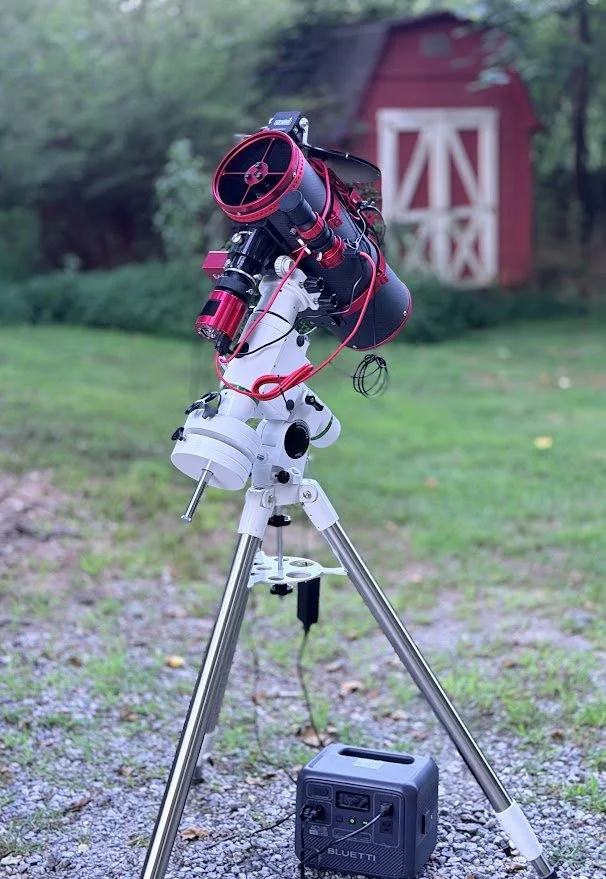
Apertura CarbonStar 150 waiting for nightfall!
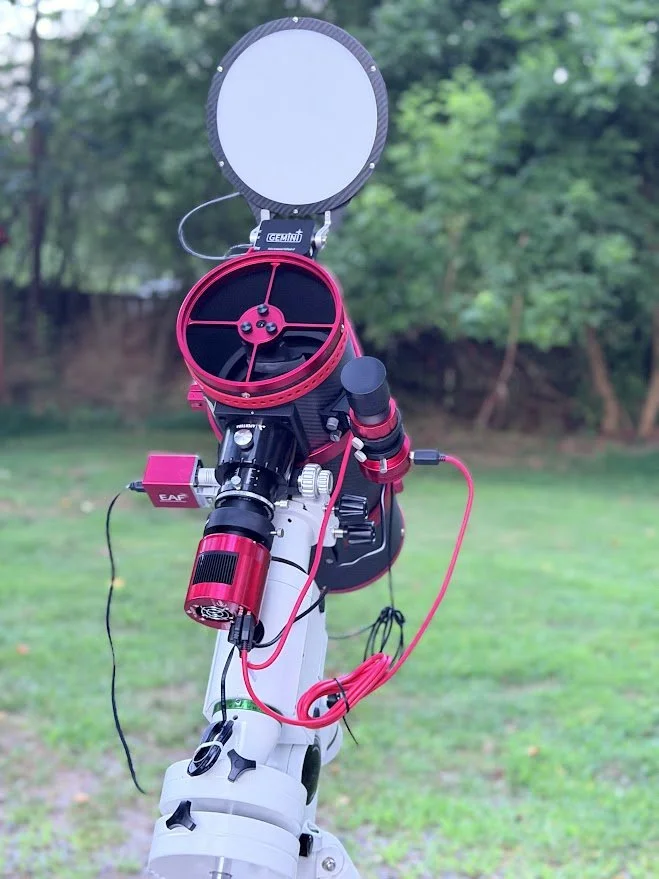
Gemini flat panel opened on the telescope
If you look inside, you can see the knife-edge baffles that Apertura installed to help reduce stray light reflections within the tube.
Finally Astropheric gave me a clear window! I setup in my front driveway, which has the clearest view of the southern sky (we have a lot of old trees around that are really tall. While thankful for them, they do get in the way of my view sometimes!). I took an extra long amount of time playing with the focuser and tracking. I used the ASIAir’s polar alignment feature to get the mount ready. This was not as seamless as I would have liked due to the clouds that kept moving through the area. These clouds also hampered my ability to guide and auto focus, so I wasted much of the night, though I believe it actually taught me more about how the whole setup worked since I had to overcome these problems.
The flat panel in operation
Once I had everything ready, I started imaging Messier 16, the Eagle Nebula. I have imaged this previously with my Seestar S50, but this would be my first try with a dedicated rig.
I set the plan in the ASIAir to capture twenty-four 300 second (5 minute) exposures. With the moon having come up in a waning gibbous phase just as I started, and with clouds coming in, I ended up with 8 total usable frames, for an exposure time of 40 minutes.
The next day I loaded the frames into Siril just to see what I could get. I had recently added the RC Astro suite of scripts to Siril and decided to try them out. After playing with quite a few settings and getting something I liked I moved the file into GIMP, a free photo editing tool, to do some final balancing.
I was blown away with what I was able to get with only 8 frames on a moony, cloudy night!
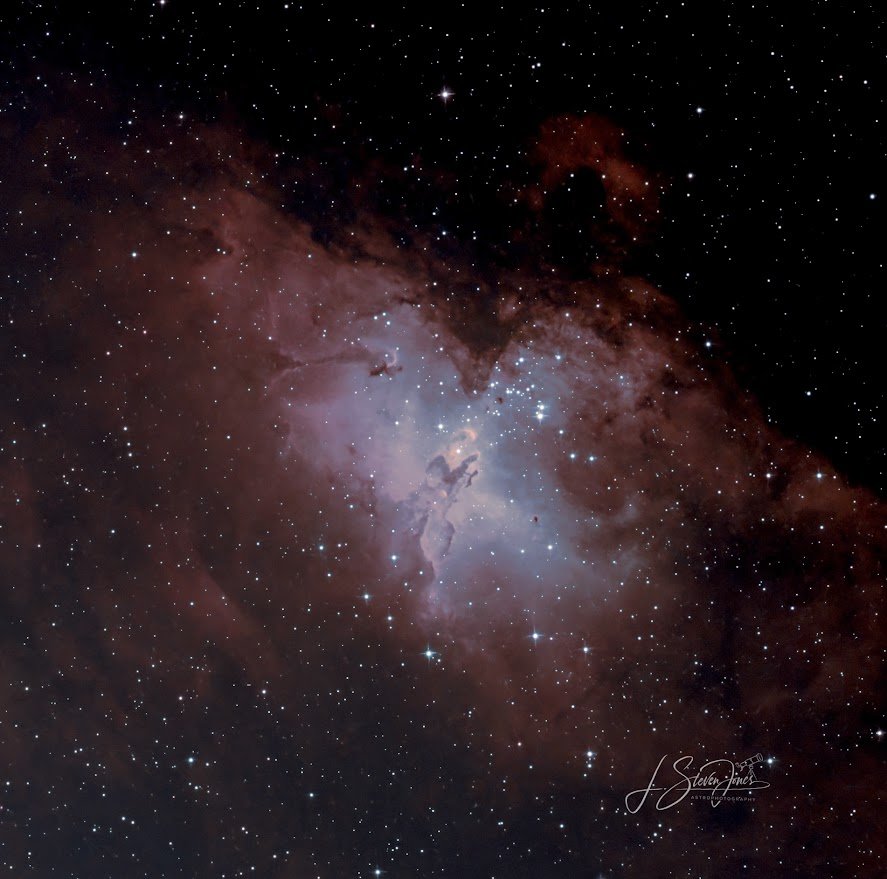
M16 The Eagle Nebula featuring “Pillars of Creation”
So I am extremely happy with this telescope! I have registered for the upcoming Green Bank Star Party at the Green Bank Observatory in West Virginia and am hoping my “box of clouds” will have dissipated by then!
Get out and look up!
*The model I received had a Crayford focuser. The newer models have been upgraded by Apertura